






Roth or Traditional? About $501,000 of Growth Makes Your Tax Rate Matter More
MarketDash Editorial Team
Author
A Roth account and a traditional account can hold the same fund, charge the same fee, and still hand you different amounts of spendable money. The difference isn't the label on the door. It's the tax rate you pay walking in versus the tax rate you pay walking out.
That's the whole argument. Not which account sounds like the responsible adult choice. Not which one your coworker with the podcast voice swears by. Two tax rates, compared. Estimate the second one and the decision mostly makes itself.
Two doors, one bill
Traditional IRA or 401(k): the money goes in before tax, often deductible, grows, and gets taxed as ordinary income when you take it out. Roth: the money goes in after tax, and qualified withdrawals in retirement are tax-free.
Same dollars either way. The IRS just collects at a different moment. A Roth is paying the restaurant bill before you eat. A traditional account is running a tab, and the tab includes dessert, coffee, and thirty years of compounding.
Neither account is noble. Neither is a personality. The math cares about one thing: is the rate you pay on the way out lower than the rate you would have paid on the way in?
The growth is where the money lives
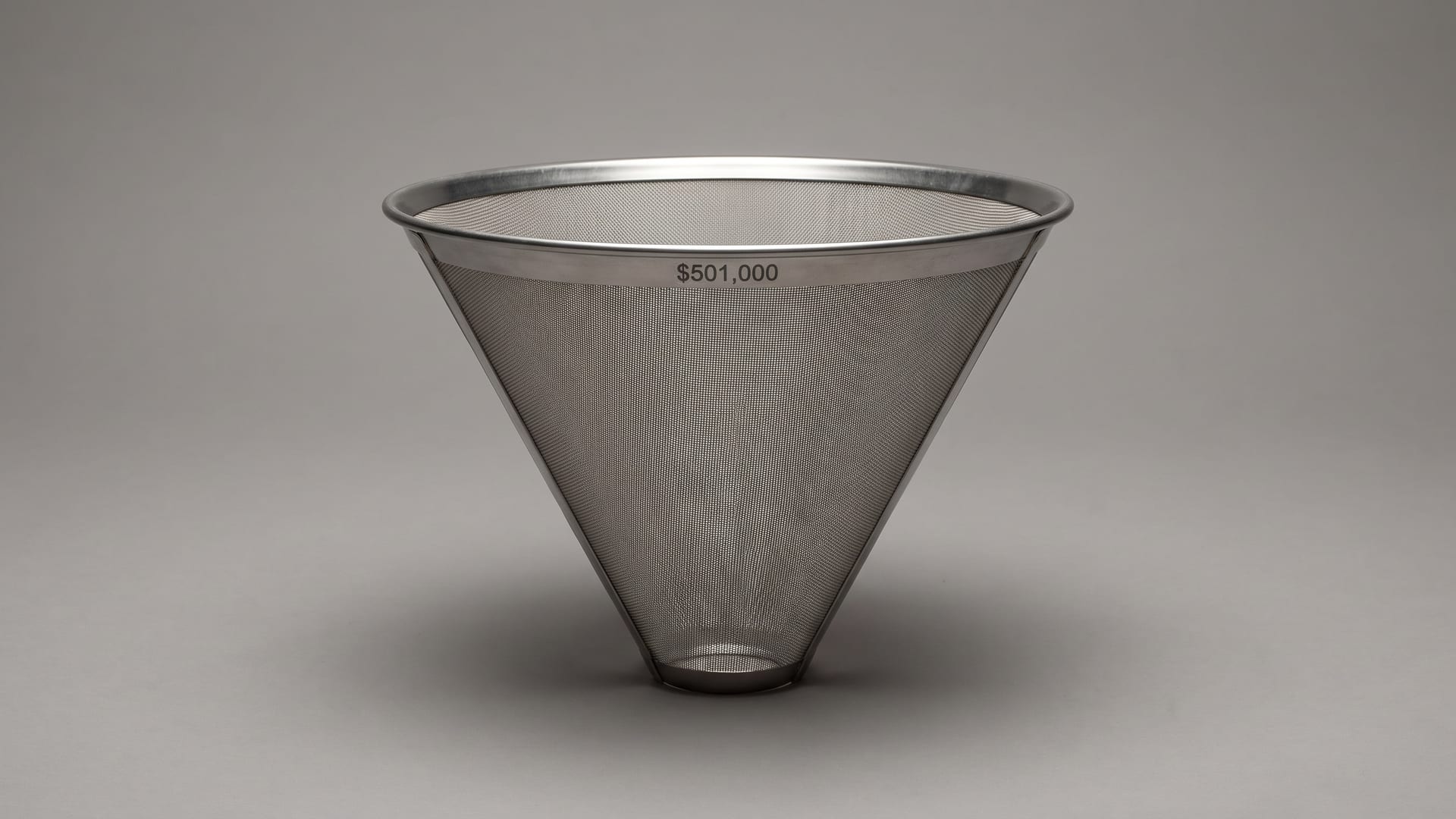
Start with $10,000, add $500 a month for 30 years, and grow it at 7% a year, before taxes and fees, not adjusted for inflation. You end with about $691,000. You put in about $190,000. The other roughly $501,000 is growth.
That split is the entire reason the account choice matters. Most of the money in the account is money the market made for you, so the tax treatment of growth swamps the tax treatment of your contributions.
In a Roth, that growth is never taxed again, provided the withdrawals are qualified. In a traditional account, every dollar of it gets taxed as ordinary income on the way out.
Which sounds like a rout for the Roth until you remember the deduction. The traditional account handed you a tax break at the start, and if you invested that break, it grew too. Most people don't invest it. It arrives as a slightly fatter paycheck, which is a terrible delivery system for a retirement plan. Spend the deduction on a nicer car and you traded the Roth's best feature for a car payment.
Guess the rate you cannot see
You can't know your future tax rate. You can get close enough to act.
Three things push it around. First, other income in retirement: a pension, Social Security, a part-time job you actually enjoy. Second, the size of your traditional pile, because withdrawals from it count as income, and required withdrawals later in life can force out more income than you were planning to take. Third, future tax law, which is a guess inside a guess.
The 4% rule is the useful frame. Research from the 1990s, William Bengen in 1994 and the Trinity study in 1998, found that withdrawing 4% of a stock-and-bond portfolio in the first year of retirement, then raising that amount with inflation, lasted at least 30 years in most historical periods. Same idea from the other direction: save 25 times your yearly spending. Spending $60,000 a year points to a portfolio of about $1.5 million.
Now flip it around. Retire with a large traditional balance and your withdrawals become income, and that income is what sets your later rate. If that rate looks higher than what you pay now, the Roth wins. Lower, and the traditional wins, because you took the deduction at a high rate and paid tax at a low one.
For intuition on the pile, use the rule of 72: divide 72 by a yearly return to estimate doubling time. At 8% a year, money doubles in about 9 years. Long runways build big balances, and big traditional balances make their own tax weather.
When the answer is "some of each"
Splitting contributions isn't cowardice. It's a hedge against your own forecast.
You will get the rate guess wrong, because tax law changes and life changes. Holding some Roth money and some traditional money lets you pull withdrawals from whichever bucket is cheaper in a given year.
There's a second reason to keep some Roth money around. Taking money out of a traditional IRA or 401(k) before age 59½ usually means income tax plus a 10% penalty, with some exceptions. If there's a real chance you need the money early, that door is spikier than it looks, and the Roth side of the house buys flexibility.
The choice is also not a tattoo. Your income moves: a raise, a promotion, a spouse who stops working, a year off between jobs. Each one shifts your current rate, and the right answer shifts with it.
Write down your two rates
Before your next contribution, do one small piece of paperwork. Write down your current rate, meaning the rate your last dollar of income lands in. Then write your best guess at your rate in retirement, plus one sentence explaining why. Compare the two. If later looks higher, send new money to the Roth. If later looks lower, take the traditional deduction.
Stick that note somewhere you'll see it, and redo the exercise whenever your income changes. That's the whole edge: the account label is marketing, and the comparison of two tax rates is the decision.
Get Market News Alerts
Real-time alerts on price moves, news, and trading opportunities.
Join 20,000+ investors. No spam, ever.
Featured Articles
View all news
Musk Confirms SpaceX-Tesla Merger Committees, Says Deal Would Be 'A Good Idea' But No Sure Thing

SpaceX Q3 Earnings: Revenue Jumps 161% as AI Segment Goes Parabolic

Super Micro Computer Stock Jumps After AI Demand Fuels Massive Q1 Guidance Raise

Capital One Crushes Q3 Estimates as Discover Deal Pays Off

United Airlines Q3 Earnings Miss Estimates, Stock Slips After Hours

Iran's Security Chief: 'Not a Single Gram' of Enriched Uranium Leaves, No US Talks Until Trump Meets Tehran's Conditions

Apollo-Backed Legendary Makes Fresh Bid For Lionsgate, Stock Jumps 16%